A tender note before you read. This is the story of losing a young person I loved, and it touches suicide and grief. Come to it only when you feel ready, and be gentle with yourself as you go.
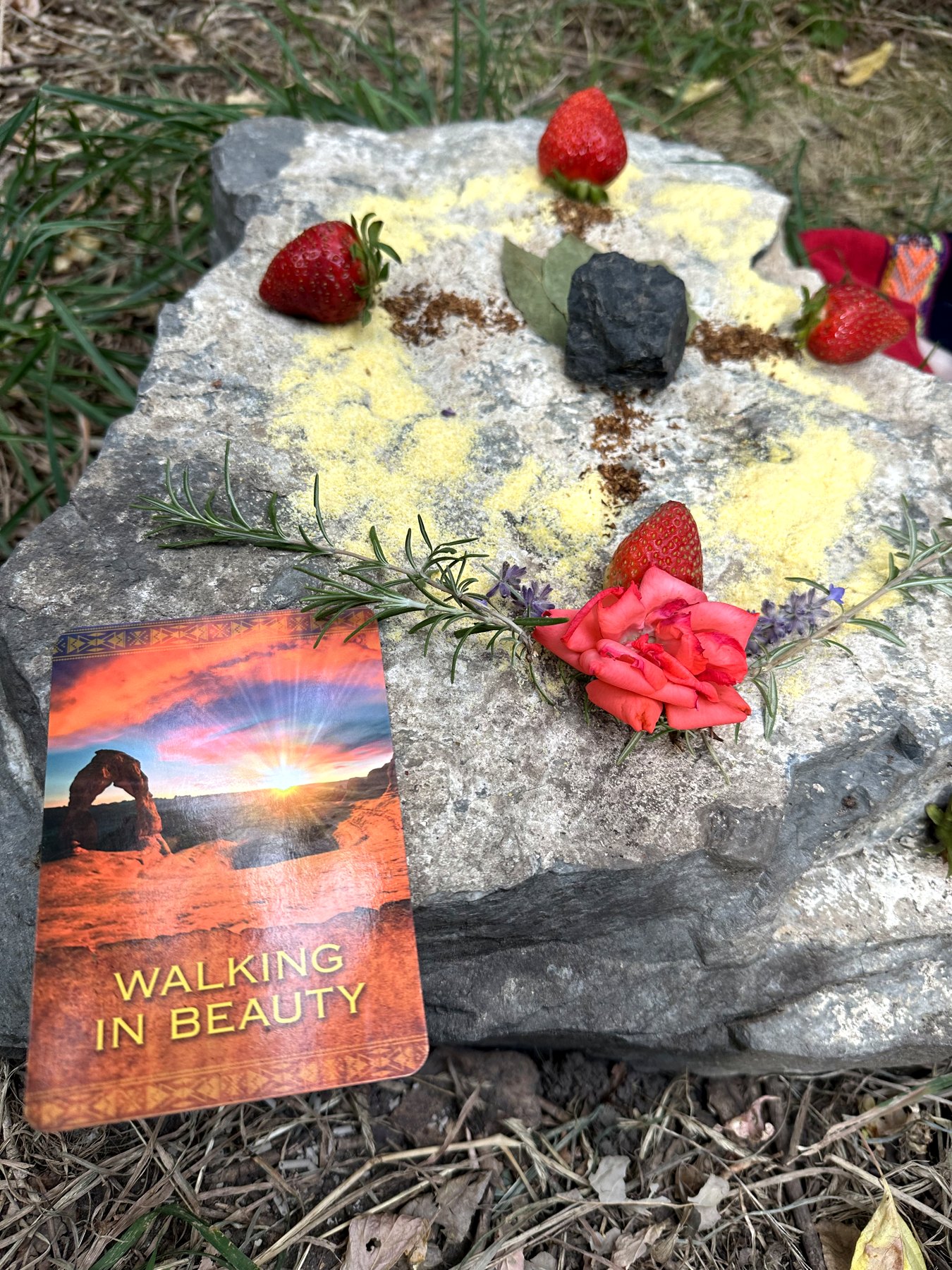
I climbed to the spot the way I had a hundred times before. Up near the Provo River, under the cottonwood that has held me through so much, the same ground where wise women once stood in a circle and held my pregnant belly in a mother’s blessing. My arms were full the way they always are when I go up there: candles, my rattle, my journal, small things gathered from my garden. The land knows me there. It has held me, and it has held this whole community, more times than I can count.
That morning, we were holding Liv.
She was fifteen. We knew she was struggling, and we told ourselves it was the usual storms of being fifteen, that particular dark night of the soul, the angst and the mood and the ache so many move through and come out the other side of. So we did what we know how to do. We sent word to the people who loved her and asked them to light a candle at ten o’clock, to hold her close in their hearts, all of us at once. One great warm beam of love, the way the Care Bears send it, every heart turned toward her at once.
I opened the sacred space. As soon as I did, her ancestors came.
The grief my body knew before my mind did
Liv was adopted. I was something like a second mother to her, and she and my children were like step siblings, growing up in and out of each other’s houses. I never knew the birth parents or blood relatives. Her birth mother and father were not part of her life; that was the agreement made long before I loved her. The little I knew was this: that her birth mother grew up African-American in Utah and felt profoundly alone, that she had Liv at fifteen, and that her own mother had her at thirteen. A line of girls becoming mothers before they had finished being children.
Under the cottonwood, I did not think about any of this. I felt it.
It rose up through my body as grief before my mind could make any sense of it. I felt the pain a young mother must have carried to make the choice she made. I felt the grandmother, and the grandmother before her. I felt a whole lineage of people brought to this country against their will, and I felt, all at once, the true size of what Liv was carrying. It wasn’t just teenage stuff, this all lived in her DNA.
I sat under that tree and sobbed. Not polite tears. The kind that come from somewhere older than you. I listened to stories I had no way of knowing, pain and violence all braided into one girl, and I spoke out loud to her ancestors. “Please hold her. Please take care of her in a way I cannot. If there is any real support in the invisible hands that came before us, let it come, and let it come now.”
The call at 1 a.m.
That night, at one in the morning, the phone rang. Liv was no longer breathing.
Shock moves through the body like a current. Your head spins. Nothing will hold still long enough to make sense. How could this be? Was the pain she was feeling so big that she believed the world would be lighter without her in it?
I will never fully understand it. None of us can fully understand the weight some of us are born already carrying, woven into us before our first breath.
Grief lives in the body
If you have ever lost someone you love, you know grief is not mostly a thought. It is felt all in the body. The hollowness in the chest. The fog in the head. The strange, floating shock you walk around inside for days. It racks you in ways that are hard to put into words.
So I want to hand you something, not an answer as to why the one you love is no longer here, but a small practice for the moments that break you open.
When the shock or the grief or the whiplash comes, place your hand on your heart, especially when it feels hollow and empty, and say out loud, gently, the way you would speak to a frightened child:
“This is something really sad and really big that happened today. And I loved them.”
(Say it as many times as you need to, and put their name in place of “them.” You are naming both the sadness and the love, and letting your body know that what you feel is real and that it is allowed.)
Then take one breath. Not to fix anything. Not to move on. Simply to be here, with your hand on your own heart, for one more breath.
You do not have to make sense of it. You do not have to be strong about it. You only have to keep breathing, and let your body grieve the way it needs to. That breath is love still moving through you: for the person, for every time you laughed together, for the holidays you will not get to share now. Let all of it move through you on the breath.
Grief will become one of your greatest teachers, in time. It asks you to look again at what you love, at who you are without them, at how to keep walking when your world has come apart. You do not have to know any of that yet. For now, there is only the breath.
I am a somatic and energy healing practitioner, not a licensed therapist. This writing is a personal offering, not medical or psychological care. If you are carrying grief, or thoughts of not wanting to be here, please reach out to someone. In the US you can call or text 988, the Suicide and Crisis Lifeline, any hour of any day. You are not meant to hold this alone.
If grief has moved into your body and you long for a gentle, grounded place to bring it, this is the work I hold. When you’re ready, I offer a free discovery call, a soft conversation to feel whether this is yours.
You are not broken. You are grieving. And grief, in the end, is only love with nowhere left to go.