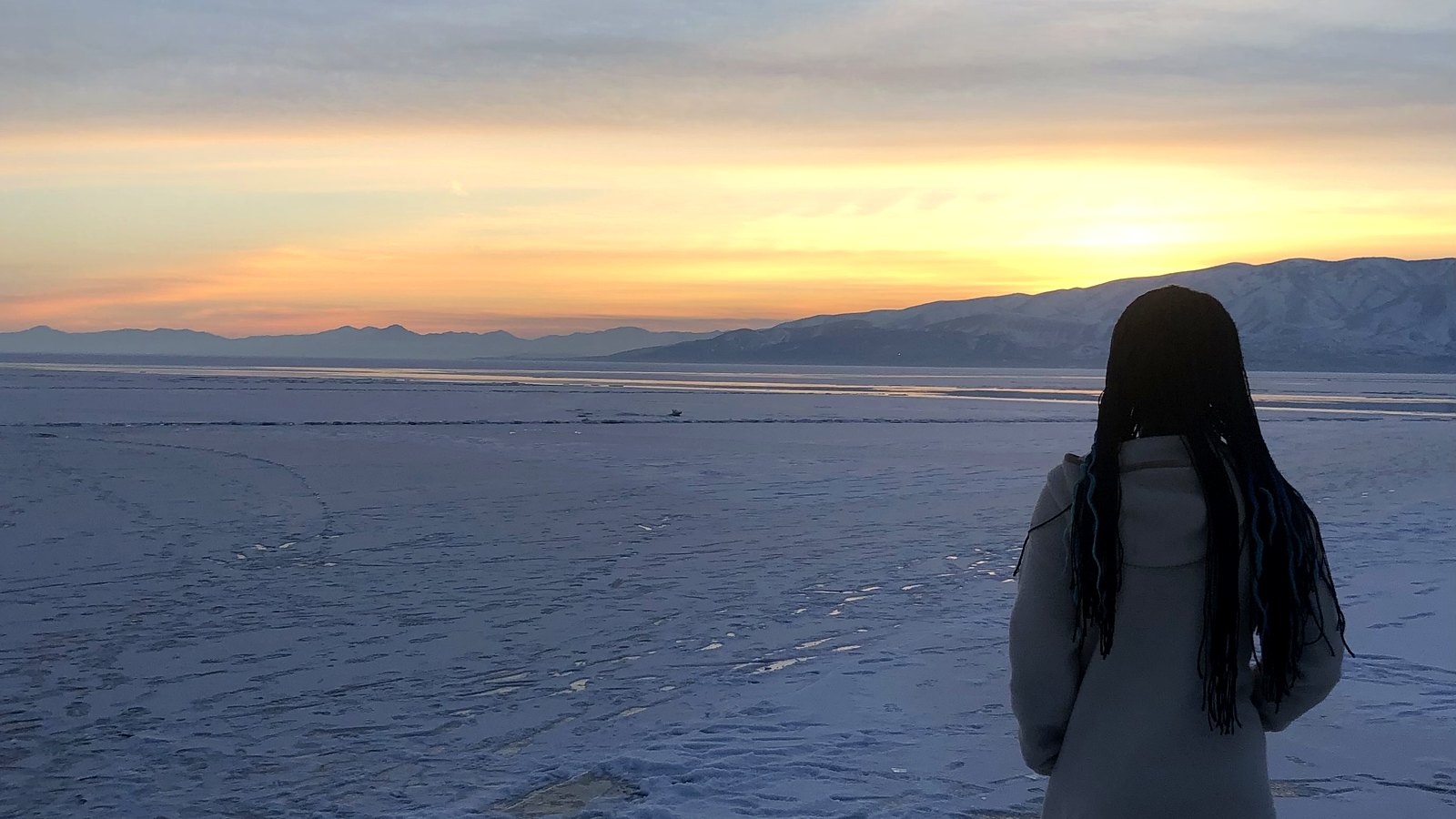
Every winter, Utah Lake freezes over. Solid enough to walk on, some years solid enough to dance on. But step out far enough and you hear it, a crackle under your shoes, the ice telling you where it will hold you and where it will not.
That is what no one warns you about leaving a religion. From the outside you look frozen solid. You left. You are free. But there are places in you, down low where no one can see, still cracking under any weight at all.
Your mind made its choice years ago. Your body is running on a different clock.
It does not live in your beliefs. It lives in your body
It is religious trauma. You made the decision to leave in your mind. But the conditioning lived underneath language, in the nervous system. For years your body had one task, to keep you safe inside a system that punished doubt and rewarded obedience. So it learned to make itself small. To hold still. To distrust its own ideas. That was never weakness. It was survival, and it worked.
The signs come in seasons
They do not show up in what you believe anymore. They show up in what you feel, and where in the body it is presenting.
In me, and in nearly everyone I hold sessions for, they arrive in two seasons.
First, the loud season, when the body erupts.
For me, my skin broke open. Psoriasis, boils, an itch that came from somewhere no cream could reach. Foods my body suddenly turned against. I was living two lives then, keeping a secret from people I loved, but my body would not keep it. It said in inflammation what words could not come out of my mouth. It felt like being caught in the desert wind, that dry, relentless wind that comes at you from every direction at once, with no wall to stand behind and no corner that is safe. It gets inside you and will not settle, and you begin to believe the agitation is simply who you are now. For you the loud season might sound different. Panic out of nowhere. A stomach that stops working. Migraines. Nights without sleep. A heaviness you cannot lift. This is the body finally screaming what you spent years swallowing. And here is the truth: the wind finally ends.
Then, the long echo.
Years pass. You rebuild. And still your body flinches. I am twelve years out, and an old hymn can catch me in the throat. Conference weekend comes and an agitation rises in me before I have even consciously remembered. I drive past a chapel I once sat in and my stomach turns. My mother still writes our names on the prayer roll, the list of names they put on the altar in the temple to pray over, and there is a particular ache in that: the place my family goes to pray for me is the exact place my body cannot bear to be. The buildings themselves seem to hold so much. This is not the eruption anymore. Wherever you are, the loud season or the long echo, you are not overreacting. Your body remembers and is keeping a promise to protect you.
Where it lives in the body
If you want to know where to look, look low.
In nearly everyone I work with, the deepest religious wounding does not live in the head. It settles in the hips, the low back, the pelvis, the root. There is a reason. So much of what a high control religion polices is your most primal ground: your worth, your desire, your body, your no. Purity, worthiness, the shame handed to you before you were old enough to question it, all of it lands in the very center of you and stays there. As tightness. As pain. As a strange numbness.
I think of the aspens. A grove of aspens is one organism underground, every tree joined root to root, passing word to one another of water and drought and the animal moving at the tree line, an entire hidden language of safety held beneath the soil. And I think of what happens when a sickness comes into that grove, it travels quietly through the whole connected system where no one can see. That is what shame does in a body. It gets into the root, into the very place meant to hold your safety, and it spreads.
Shame is how these systems hold you. Make a person feel unworthy, and they will keep coming back to be made clean. So when I work with somebody, we often begin right there, at the root, with the most radical question I know. Who told you this was shameful? Because it was almost never you.
How it begins to heal
I know something about roots that will not hold you up, because mine quite literally crumbled. In the hardest stretch of my divorce and the process of leaving the church, my low back and everything in me did not want to stand up straight, when I did not know who I would even be on the other side of all this unraveling, I went down to the river. There is an old song about going down to the river to pray. I went down to the river to heal. A cottonwood grows there, one of those old trees that rise up beside the water and seem to watch over the land. I put my arms around it and held on. I yelled. I got angry. I told that cottonwood my whole story, and I borrowed its rootedness because I had none of my own. I leaned into its roots until, slowly, I could feel my own again.
The cottonwood taught me what I most needed to know, that roots do not knit back in a day, and neither does a person. Healing does not move in a straight line. It comes the way spring comes to Mount Timpanogos: freeze and thaw and freeze and thaw, the snow melting and hardening and melting again, until one warm week the trail is finally open. And you, too, begin to learn which places in you can hold your weight now, and which are still thin ice. That is not failure. That is thawing. That is a body coming up out of survival, at last, on its own clock.
You are not broken
If you carry one thing away from this, let it be this. The nausea on the temple grounds, the ache low in your back, the wind that howled through you for years, none of it means something is wrong with you. It means the opposite. It means your body loved you so fiercely it stood guard long after the threat was gone. It was never betraying you. It was protecting you, the only way it knew how.
And a body that learned to brace can also learn to soften. Not by force, never by force. It loosens the way a frozen river loosens, cracking as it goes, until the roots take hold once more and the snowed-in trail lets you through at last.
A gentle note: I am a somatic and energy practitioner, not a licensed therapist. This work walks alongside healing and growth. It is not a replacement for therapy or medical care, and many of the people I sit with do both. That is a good and beautiful thing.
If any of this read like a page from your own life, there is a soft place to begin. A free discovery call, twenty unhurried minutes, no pressure and nothing to sell, just space to be heard by someone who has stood where you are standing.
You left the church a long time ago. Now let’s help the rest of you come home.