The religion I grew up in had no real rituals for grief. When someone died, what we had were reassurances. Isn’t it wonderful that you will see them again. Isn’t it wonderful that they are in a better place. All of it kind, all of it well meant, and all of it a quiet instruction to hurry up and be okay.
But grief does not want to be reassured. Grief wants somewhere to go.
I did not learn that until my best friend Briana died, and the grief of it lived in my body with nowhere to put itself. So I went looking, and I found what so many cultures older and wiser than mine had always known: that we are meant to make ceremony for our dead. That ritual is not a way to move on from someone. It is a way to keep them woven into your life, season after season, for as long as you live.
Why ritual moves grief
Here is what I have come to understand, in my own body and in the bodies of the people I sit with. Grief that lives in the body wants expression. You can understand your loss completely, you can talk about it for years, and still it sits there, dense and unmoving, because understanding happens in the mind and grief lives lower down.
Ritual is how you give grief an action. A place to put your hands. Something to light, to cook, to plant, to set out and look at. It takes the ache that has no words and gives it a form, and in that form the grief can finally move. This is what the old cultures have always known. They hold month-long vigils. They build altars. They set a place at the table. They make grief a lived and active and embodied thing instead of a feeling to be tidied away. Our bodies know the difference.
Building an altar for the ones you love
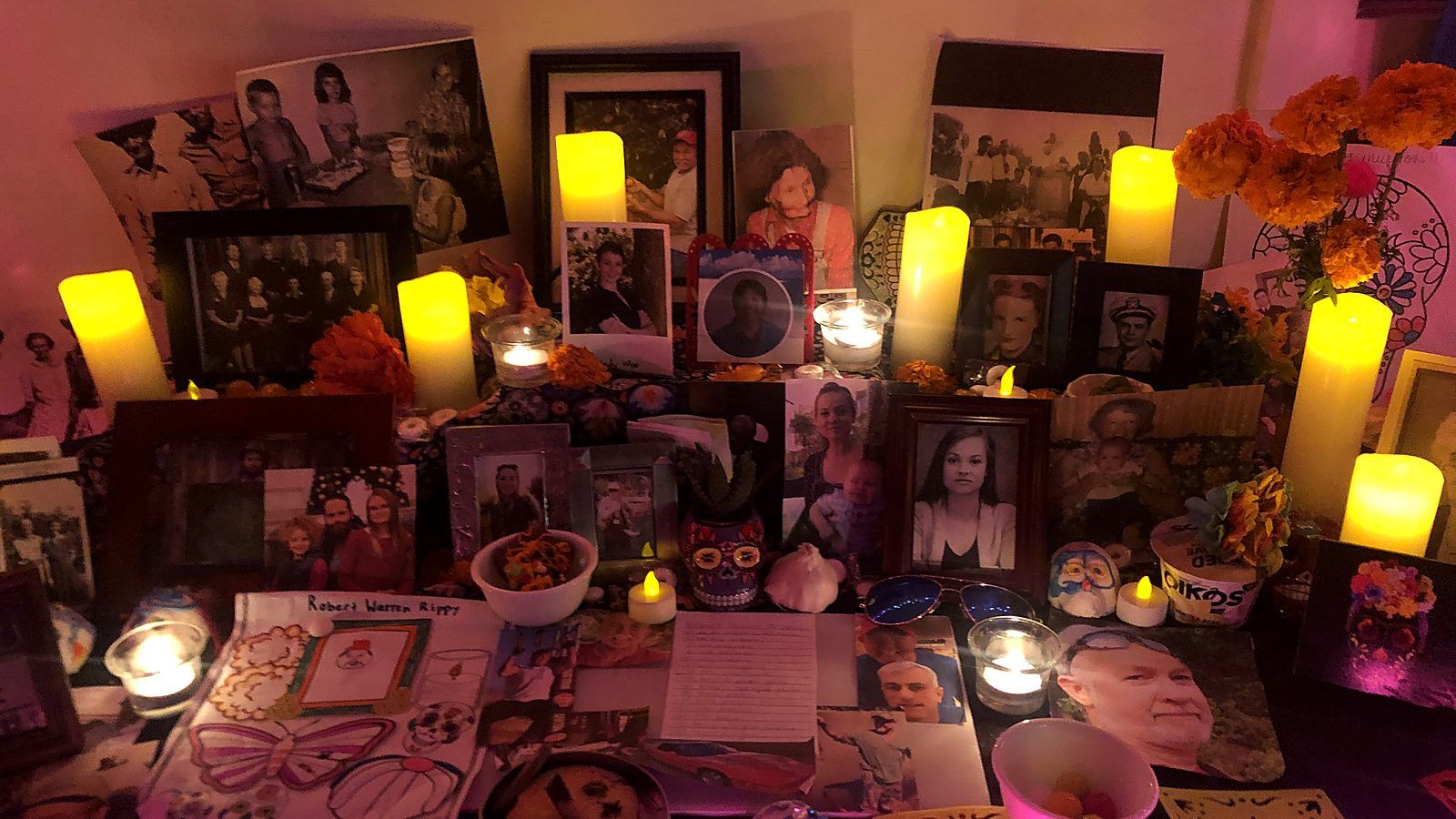
The ritual that changed everything for me was Día de los Muertos, the Day of the Dead, a tradition taught to me from an amazing woman from a culture that treats death with marigolds and rich food. Each year, at the beginning of November, I build an altar.
It started small, just a photograph or two. Now it has grown. There is my grandfather. There is Briana. Over the years the altar has quietly expanded, the way grief itself expands to hold more of a life. If you want to build one of your own, know that there is no wrong way to do it. But here is what mine holds. Photographs of the ones I have lost, their faces where I can see them. Their favorite candies, and meals cooked the way they loved them, until the whole house fills with the smell of their memory. A few small things that were theirs, a candle, a flower, something carried in from the earth. And marigolds when I can find them, the flower said to guide the dead home.
And then I sit with it. I let them be not a closed chapter but a living presence, woven back into the turning of my year. Day of the ancestors has become a season I get to spend with them.
The small rituals that keep them close
An altar is not the only way. Over the years I have gathered smaller rituals too, and each one is a thread that keeps the people I love near.
On the anniversary of Briana’s death, I buy a new fern. A living thing, green and slowly unfurling, to mark the day she left and to keep something of her growing in my home.
I put my hands in the garden, because Briana loved to cook with what she grew. Tending the soil, pulling the weeds, letting my tears go down into the ground and become part of something living, that is its own kind of prayer.
And there is the quietest ritual of all. The daughter I carried just after Briana died bears a piece of her name. Every time I call my daughter home, I am also saying my friend’s name out loud. Some rituals you build with your hands. Some you get to live inside for the rest of your life.
How to begin your own
If you have lost someone and you do not know what to do with the grief still sitting in your body, you can begin very small. You do not need to know how. You only need to give the love somewhere to go.
Choose one photograph and set it somewhere you will see it. Light a candle beside it. Cook the one dish they loved, and eat it slowly, and let yourself remember. Pick a date, their birthday, the day they died, the turning of a season, and let that be the day you tend them each year. That is all an altar is. A place where you tell the truth that they mattered, and that they still do.
The grief will come when you do this. Let it. That is the whole point. The tears are not the ritual failing. They are the ritual working, the grief is moving through you and out, the way it was always meant to.
Love, still moving
We are not built to tidy our dead away. We are built to carry them, to set a place for them, to keep saying their names into the turning year. Ritual is simply love, still moving, given something to do with its hands.
So build the altar. Cook the food. Plant the fern. Say the name. And let the ones you love stay woven, season after season, into the fabric of your living life.
A gentle first step
If your grief has been sitting in your body with nowhere to go, and you long for a way to tend it, you do not have to find that way alone.
You can book a free discovery call, twenty unhurried minutes, no pressure and nothing to sell. Just space to be heard, and to begin giving your grief, and your love, somewhere to go.
A gentle note: I am a somatic and energy practitioner, not a licensed therapist or grief counselor. This work walks alongside healing, and it is not a replacement for therapy or medical care. If your grief feels unbearable, or you are struggling to stay safe, please reach out to a licensed professional. Many of the people I sit with do both, and that is a good and beautiful thing.